
THE MACHINE - Chapter 4: Championship
The Oklahoma City Thunder Dynasty - A Sports Fiction Novel
THE MACHINE
The Oklahoma City Thunder Dynasty
A Sports Fiction Novel
Chapter 4: Championship
June 4
It starts the way most Thunder games start that season — with Oklahoma City doing exactly what everyone expects and Indiana refusing to accept the script.
Paycom Center is the loudest it has been all season for Game 1 of the 2025 NBA Finals. The building holds 18,203 people and every single one of them has been waiting for this moment — some for years, some for the entire sixteen seasons the franchise has existed in Oklahoma City, some for a lifetime of following a team that was always good enough to dream about but never quite good enough to hold the trophy.
The Thunder take a fifteen-point lead in the fourth quarter.
They lose by one.
Tyrese Haliburton — the Pacers’ All-Star point guard, who has spent these entire playoffs orchestrating last-second miracles the way other players run pick-and-rolls — catches a pass at the elbow with 0.3 seconds on the clock, rises, releases, and watches the ball arc toward the basket in the silence that falls over a sports arena when everyone in the building holds their breath simultaneously.
It goes in.
Pacers 111, Thunder 110.
The Oklahoma City bench stands frozen. SGA — who scored 38 points in a losing effort — sits at halfcourt for a long moment before walking toward the tunnel. The expression on his face reveals nothing. It never does.
In the stands, 18,203 people try to process what just happened.
Three rows back from the OKC bench, Sam Presti watches the Pacers celebrate. His expression also reveals nothing. He is already thinking about Game 2.
Indiana had been doing this all season.
The Pacers were the comeback kings of the 2025 playoffs — a team that had more wins from fifteen points down or more (five) than the rest of the entire league had combined. They had stunned Milwaukee in the first round. They had beaten Cleveland in five. They had eliminated the New York Knicks in six games in a rematch of their famous 2024 playoff series. Every time Indiana lost a game, they simply came back and won the next one.
Now they had done it on the NBA’s biggest stage.
Oklahoma City, the best team in basketball, the 68-and-14 juggernaut that had beaten the Memphis Grizzlies four straight, ground out a seven-game war with the Denver Nuggets, and swept aside the Minnesota Timberwolves in five — had just blown a fifteen-point lead in the fourth quarter of the NBA Finals.
For forty-eight hours, the national conversation was about whether the Thunder could close. Whether Daigneault could make adjustments. Whether SGA could handle the pressure of a Finals atmosphere in a way that his regular season dominance hadn’t yet been tested by.
Then Game 2 happened.
SGA scored. And scored. And scored.
Thunder 123. Pacers 107. Series tied.
Games 3 and 4 are the Games that define what kind of team Oklahoma City actually is.
In Game 3 in Indianapolis, the Pacers’ bench detonates. Bennedict Mathurin scores 25 points off the pine — the most by a bench player in a Finals game in years. Haliburton finds a rhythm, finishing with 22 points and 11 assists. SGA has 6 turnovers — a postseason career high at that point — and the Thunder lose by nine.
Pacers lead the series 2-1.
The sports radio stations in Oklahoma City run hot for twenty-four hours. The national media begins writing narratives about Indiana’s resilience and OKC’s youth. Second-guessing. Process critique. The familiar chorus of voices that has shadowed this franchise since the Durant years — the suggestion, never quite spoken aloud but always present, that Oklahoma City is a place where great teams come to be almost enough.
In Game 4, with OKC trailing by ten in the second half at Gainbridge Fieldhouse, Shai Gilgeous-Alexander answers every one of those voices.
He scores 15 of his 35 points in the final four minutes and thirty-eight seconds. Not in a flurry — methodically, deliberately, each basket arriving at exactly the moment the game requires it. A mid-range jumper. A free throw pair. A pull-up over Pascal Siakam’s outstretched hand. OKC closes on a 16-7 run. The Thunder win 111-104.
“He definitely showed who he is tonight,” Daigneault says after the game.
Series tied 2-2.
Jalen Williams — who added 27 points and watched his teammate carry the team in the closing minutes — puts it more simply in the locker room, away from the cameras: “That’s why he’s the best player in the world.”
Alex Caruso, the veteran presence who has been here before — who has won championships and lost championships and knows the difference between the two — nods from his locker.
“Now we know,” Caruso says. “Now everybody knows.”
Game 5 belongs to Jalen Williams.
It is the performance that announces Williams as something more than a second option or a complementary star. It is the game that makes the case — to the national media, to the skeptics, to the league at large — that Oklahoma City has not one transcendent player but two.
Indiana fights back from eighteen points down to within two in the fourth quarter. It is the exact same game as Game 1 — the Pacers clawing, grinding, doing what they have done seventeen times this postseason. The crowd at Paycom Center feels it. The collective memory of 0.3 seconds and Haliburton’s elbow jumper is alive in the building.
Then Williams catches it on the right wing. The Pacers are within two. The crowd is holding its breath.
Williams shoots.
The ball goes in.
OKC erupts.
Williams finishes with 40 points on 14-of-24 shooting — a career playoff high. SGA adds 31 with 10 assists. Together they account for more combined points than entire Indiana rotations. The Thunder win 120-109.
“Tonight was the exact same game as Game 1, to be honest,” Williams says afterward. “Learning through these Finals is what makes this team good and we were able to do that.”
OKC leads 3-2. One win from the championship. The city of Oklahoma City barely sleeps.
Game 6 goes to Indiana.
The Pacers — playing at home, playing with desperation, playing the way teams play when they are staring at elimination — are magnificent. They dominate from the opening tip. The Thunder shoot poorly. The Pacers shoot well. Final: 108-91.
Series tied 3-3.
It is the 47th time in these playoffs that the team that lost a game came back to win the next one — the Pacers’ trademark, their defining characteristic, the reason a 50-win team from Indiana is playing in the NBA Finals while sixty-win teams from the Western Conference have gone home.
Back to Oklahoma City. Game 7. June 22, 2025.
The morning of Game 7, Sam Presti arrives at his office at 6:47 AM.
This, too, is not unusual.
He makes coffee in the small kitchen down the hall. He sits in front of his three monitors. On one of them — the leftmost — is the scouting report for tonight. On the middle one is a statistical breakdown of Indiana’s tendencies in elimination games. On the rightmost monitor, slightly minimized, slightly pushed to the edge of the screen: the 2028-29 cap projections.
Always already somewhere else.
What happens in Game 7 of the 2025 NBA Finals will be shown in highlight packages for decades.
Tyrese Haliburton — who has been playing through the leg injury that has hampered him since Game 5 — aggravates his Achilles in the first quarter and is reduced to a ghost of himself. The Pacers play on without their best player operating at full capacity, which says something extraordinary about the depth and character of Indiana’s roster. But they are not enough.
OKC leads at halftime. Indiana rallies. Myles Turner ties it at 56-56 with 8:32 left in the third quarter and the building — genuinely, for a fleeting moment — does not know what is about to happen.
Then SGA hits a three-pointer from the top of the key.
Then Chet Holmgren, the 22-year-old center who spent his entire rookie season watching from the sideline with a hip injury and came back to become one of the best two-way big men in the league, posts 18 points, 8 rebounds and 5 blocks in the most important game of his career.
Then OKC creates 18 points off turnovers in the third quarter alone — Indiana’s trademark turned against them, the comeback kings unable to get stops when stops are the only thing that matters.
Thunder 103, Pacers 91.
OKC wins the series 4-3.
SGA finishes with 29 points and 12 assists. His Finals averages: 30.3 points, 5.6 assists, 1.9 steals, 1.6 blocks. The Bill Russell NBA Finals MVP trophy is brought to center court.
He accepts it the same way he does everything — without apparent emotion, with complete composure, with the expression of a man who has always known this was possible and never needed anyone else to believe it before he did.
He says the thing about dreaming. He says the thing about everyone who was in his corner. And then he turns, finds Jalen Williams in the crowd of teammates, and extends the trophy toward him.
“We did this together.”
Williams takes it. He holds it up. The building — 18,203 people who have been waiting for this for sixteen years — erupts with a sound that can be heard for blocks in every direction.
Outside Paycom Center, on the streets of Oklahoma City, people who have no tickets are standing on the sidewalks listening to it through the walls.
The smallest market in professional basketball has its first championship.
Three miles away, in the house where his family has gathered to watch the game, a kid who will be ten years old next month is sitting on the living room floor in an SGA jersey, watching the confetti fall.
He doesn’t know yet that he wants to play in the NBA. He doesn’t know yet that Oklahoma City will be the place where his generation’s basketball dreams are formed and tested. He doesn’t know that the dynasty whose first championship he is watching right now — in real time, on the floor in his living room — will produce eight more titles before he is old enough to fully understand what he has witnessed.
He just knows that SGA is the best player in the world, that the Thunder won, and that this feeling — whatever this feeling is — is something he wants to be close to for the rest of his life.
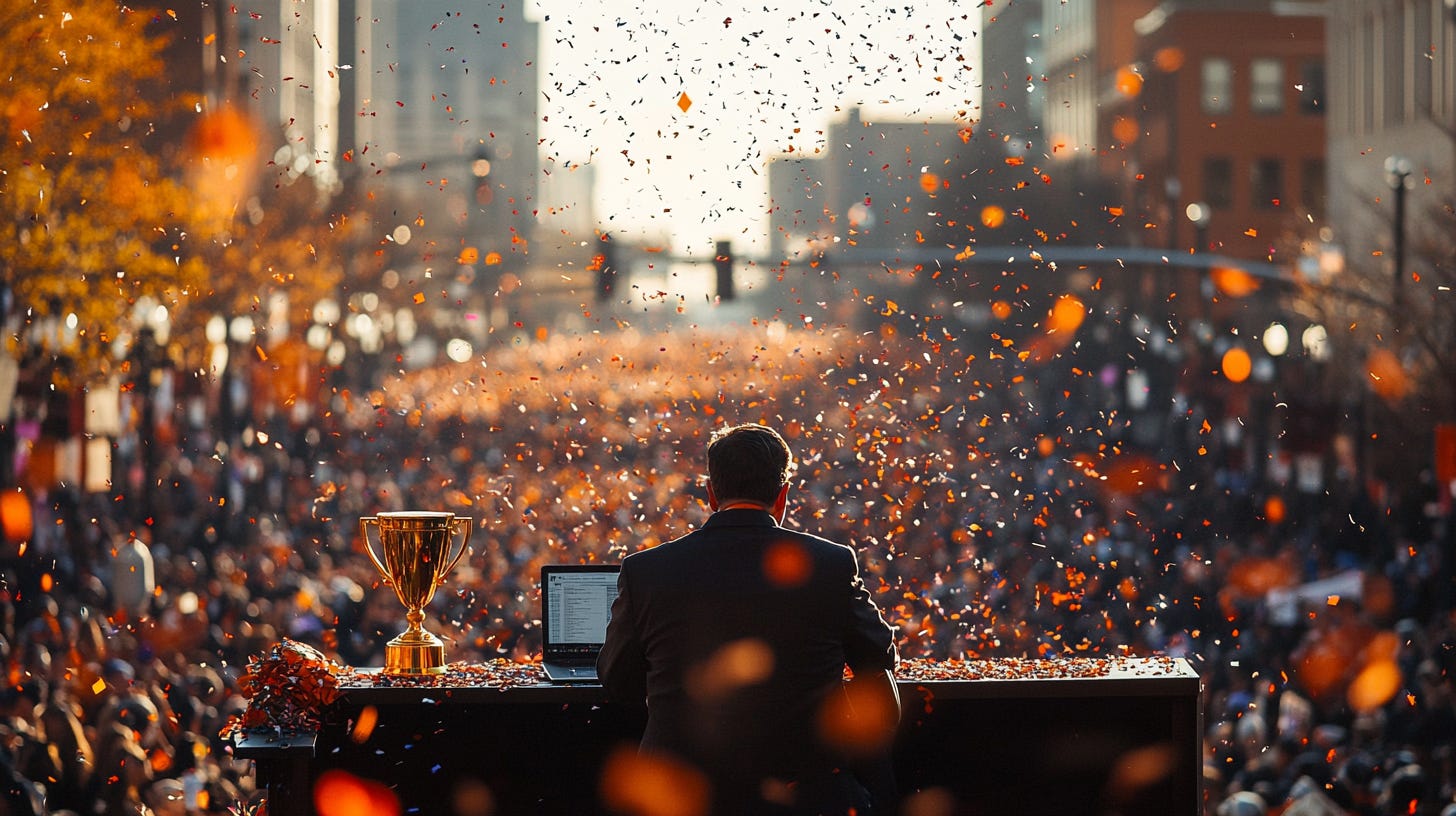
On his television screen, confetti keeps falling.
The next morning, June 23rd, Sam Presti is back in his office at 6:47 AM.
The championship parade is scheduled for Thursday. The trophy sits somewhere in the building — in a conference room, probably, being photographed by the team’s media staff. The locker room still smells faintly of champagne.
Presti opens his laptop. He minimizes the 2028-29 cap projections — he was almost done with that model anyway — and opens a new document.
He titles it: 2026 Offseason Planning.
The dynasty has its first championship.
It is time to start building the second one.
Tomorrow: Chapter 5 — “Ajay Mitchell and the Lakers” — The full story of the breakout that changed everything. The Belgian-born second-round pick nobody outside Oklahoma City had heard of. And the series against the Lakers that made the world pay attention.
— End of Chapter 4 —
The Machine is a sports fiction novel published daily throughout June. Subscribe to receive each chapter directly to your inbox every morning.
Missed the beginning? Chapter 1 is here: [THE MACHINE - Chapter 1: The Smallest City in the League] — Chapter 2 is here: [THE MACHINE - Chapter 2: The Machine Beneath The Machine] — Chapter 3 is here: [THE MACHINE - Chapter 3: SGA]
📊 DYNASTY TRACKER Updated each chapter
🏆 Championships: 1 — June 22, 2025 — Thunder 103, Pacers 91 — Game 7 👤 SGA: Finals MVP — 30.3 PPG, 5.6 APG, 1.9 SPG, 1.6 BPG for the series 🌟 Game 7 heroes: SGA 29pts/12ast — Holmgren 18pts/8reb/5blk 🎯 Series turning point: Jalen Williams 40pts in Game 5 📋 Future picks: Multiple future firsts owned through 2032 💰 Luxury tax status: Non-taxpayer 🏀 2025 playoff path: Memphis 4-0 → Denver 4-3 → Minnesota 4-1 → Indiana 4-3 📖 Chapter focus: The 2025 NBA Finals — game by game