
THE MACHINE - Chapter 1: The Smallest City in the League
The Oklahoma City Thunder Dynasty - A Sports Fiction Novel

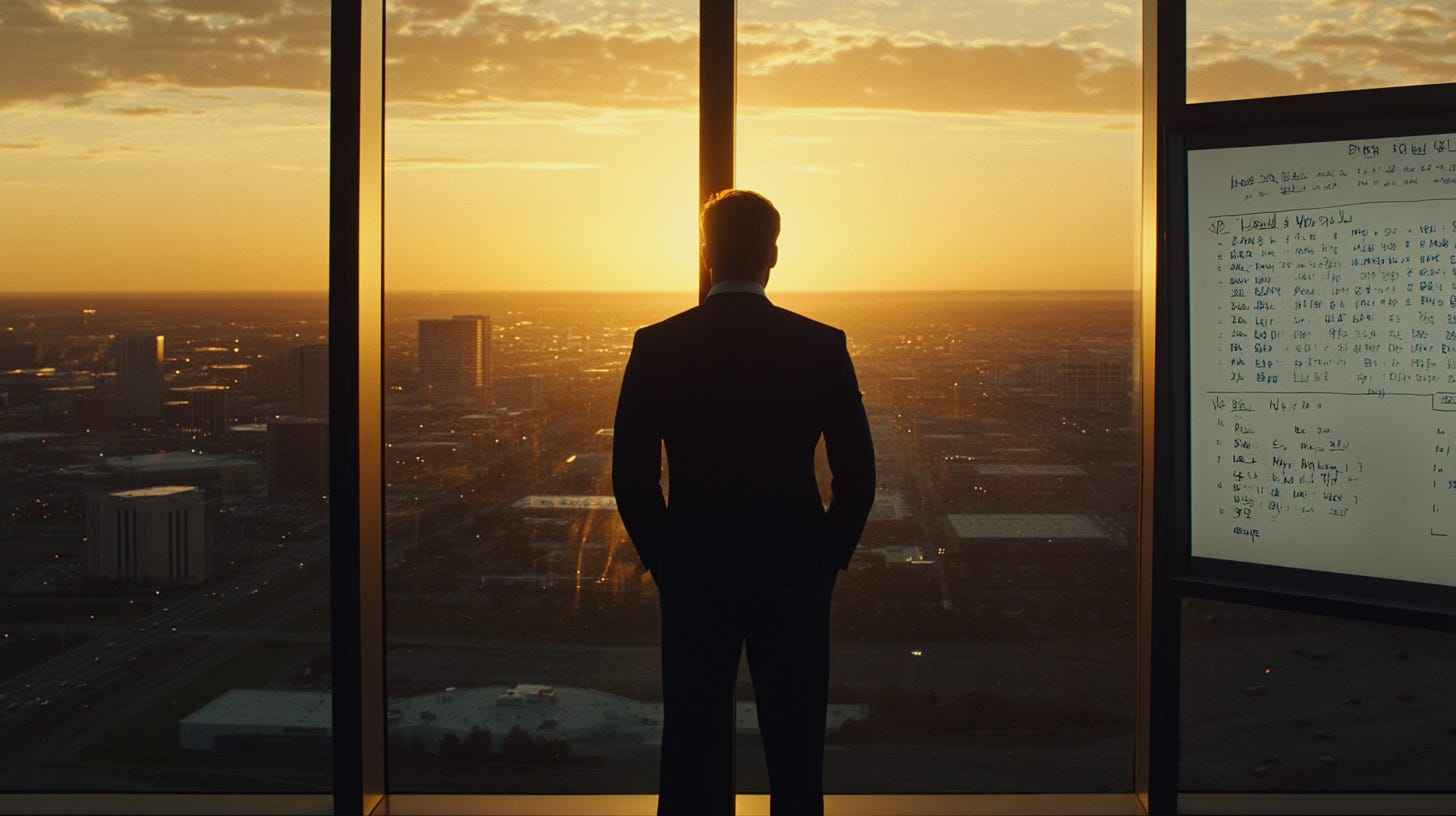
THE MACHINE
The Oklahoma City Thunder Dynasty
A Sports Fiction Novel
Chapter 1: The Smallest City in the League
June 1
The morning of Game 1 of the 2025 NBA Playoffs, Sam Presti arrived at his office at 6:47 AM.
This was not unusual. In fifteen years as General Manager of the Oklahoma City Thunder, Presti had developed the habit of arriving before the cleaners finished, before the security guard changed shifts, before the city outside had fully decided to wake up. He made coffee in the small kitchen down the hall from his office — the same kitchen the players used, the same ancient drip machine that had been there since the Kevin Durant years — and he carried his mug back to his desk and sat down in front of three monitors displaying spreadsheets that most people in professional basketball would need a graduate degree to fully understand.
Outside his window, Oklahoma City was just beginning to stir.
It was April. The sky over downtown was the particular pale grey of early spring mornings on the Southern Plains — not quite overcast, not quite clear, the kind of sky that couldn’t make up its mind. On the street below, a woman walked a golden retriever past the Paycom Center arena. A delivery truck idled at a red light. A teenager in a Thunder hoodie jogged past on the sidewalk, earbuds in, oblivious to everything except whatever was playing and the rhythm of his feet on the pavement.
The city had 700,000 people. It was the smallest market in professional basketball. It had no ocean, no mountains, no international airport with direct flights to everywhere, no celebrity culture, no fashion week, no financial district gleaming with ambition. What it had was this: flat land stretching to every horizon, a sky bigger than anywhere else you’d ever been, a fierceness about its own identity that came from decades of being underestimated, and right now, in the spring of 2025, the best basketball team in the world.
Presti knew the numbers. He always knew the numbers.
His team had finished the regular season 68 and 14. The best record in the NBA. The best record in Thunder franchise history. They had the league’s Most Valuable Player in Shai Gilgeous-Alexander, who had averaged 32.7 points, 5.0 rebounds and 6.4 assists on his way to the most dominant individual regular season Oklahoma City had ever witnessed. They had a 22-year-old center in Chet Holmgren who could change the outcome of a game without scoring a single point — blocking shots, altering drives, protecting the rim with the quiet authority of someone who had been doing it his whole life. They had Isaiah Hartenstein — physical, relentless, the ideal complementary big — anchoring the frontcourt alongside Holmgren and giving OKC a toughness that purely skilled teams could never manufacture. They had Alex Caruso, the veteran defensive specialist who brought championship experience and an almost irrational competitive intensity to every minute he played. They had Lu Dort — relentless, physical, the kind of defender who made opposing guards genuinely dread getting out of the team bus — and a young Cason Wallace already showing the perimeter defensive instincts that would define his career for the next decade. They had Jalen Williams, quietly developing into one of the most complete two-way players in the league. They had depth and they had health and they had something rarer than either of those things.
They had belief.
Not the manufactured belief of a locker room speech or a motivational poster. The real kind. The kind that comes from three years of building something together, of watching each other grow, of losing in the playoffs and coming back the next season better, of trusting a system and a coach and a front office that had proven — slowly, then all at once — that it knew exactly what it was doing.
Presti sipped his coffee and opened the file he had been working on for the past six months.
It was not a scouting report on their first-round opponent. That work was already done — had been done for weeks, distributed to the coaching staff, memorized, game-planned, refined. The Memphis Grizzlies had been studied from every angle. Their tendencies, their weaknesses, their personnel matchups. Daigneault’s staff had built a defensive scheme specifically designed to neutralize Memphis’s most dangerous offensive weapons, and SGA had spent three separate film sessions studying exactly how to attack their primary ball handlers on the other end. The preparation was complete. What Presti was studying on this particular morning, the morning of Game 1 of the 2025 NBA Playoffs, was a salary cap projection document for the 2028-29 season.
This was the thing about Sam Presti that people in Oklahoma City had spent fifteen years trying to understand and never quite managing: he was never fully present in the moment everyone else was living in. While the city was consumed by tonight’s game, Presti was consumed by a future that didn’t exist yet. While fans argued about playoff matchups and starting lineups and whether Holmgren’s shoulder was really a hundred percent, Presti was calculating luxury tax thresholds three years out and modeling what the roster would look like when certain contracts expired and sketching the outline of a dynasty that extended far beyond any individual season.
He had been this way his entire career.
It had made him, depending on who you asked, either the greatest general manager in the history of professional basketball or the most infuriating. Possibly both.
Three floors below Presti’s office, in the Thunder’s training facility, Shai Gilgeous-Alexander was already on the court.
He had been there since six. He would be there until nine, return for shootaround at eleven, rest in the afternoon, and arrive for Game 1 at five — four hours before tip-off — to begin the methodical preparation that had become as much a part of his identity as the smooth, unhurried way he moved on the basketball court.
SGA was twenty-six years old. He was six feet six inches tall and weighed two hundred and ten pounds. He had arms that seemed slightly too long for his body and a resting expression that conveyed absolutely nothing — no emotion, no urgency, no indication of whether he was about to score forty points or grab a cup of water. He had grown up in Hamilton, Ontario, the second-largest city in a region of Canada that produced hockey players the way Oklahoma produced oil, and he had fallen in love with basketball the way second children sometimes fall in love with things their families don’t entirely understand — quietly, completely, with a commitment that needed no external validation.
He had been traded to Oklahoma City in 2019 as part of the Paul George deal. He had been twenty years old. He had sat in Sam Presti’s office on his first day as a Thunder player — Presti behind his desk, SGA in the chair across from him, the cap projection spreadsheets discreetly minimized on the monitors — and Presti had said something that SGA had never forgotten.
“I’m going to ask you to be patient,” Presti had said. “Not because I don’t think you’re ready. But because what we’re building here takes time, and if you trust the process, what’s waiting at the end of it is worth more than anything you could chase in the short term.”
SGA had nodded. He had understood. He was, by nature and by upbringing, a patient person.
Six years later, standing at the free throw line at 6:14 in the morning, shooting his five hundredth free throw of the session, SGA allowed himself the smallest of smiles.
The patience had paid off.
The thing people got wrong about the Oklahoma City Thunder — the thing television analysts got wrong, the thing opposing front offices got wrong, the thing even some of their own fans got wrong — was thinking the 2025 season had come out of nowhere.
It hadn’t come out of nowhere. It had come out of everything.
It had come out of the night Kevin Durant left for Golden State in 2016 — the worst night in franchise history, a gut-punch betrayal that left the city feeling like something had been taken from it that it hadn’t even known it valued until it was gone. It had come out of the Russell Westbrook era — thunderous and thrilling and ultimately heartbreaking, a one-man war against the mathematics of basketball that produced individual brilliance and collective failure in roughly equal measure. It had come out of the decision to trade both Paul George and Russell Westbrook in 2019, accepting short-term pain for long-term gain, receiving in return a collection of future first-round picks and a quietly brilliant 20-year-old Canadian guard who nobody outside basketball obsessives had properly noticed yet.
Every star who left had become a draft pick. Every painful departure had become future capital. The Thunder had turned heartbreak into ammunition with the patience and precision of an organization that understood, at its cellular level, that the goal was never to win one championship. The goal was to build something that won championships the way great organizations win things — consistently, sustainably, across generations.
By the spring of 2025, OKC had accumulated more future first-round picks than any team in the history of the NBA. They had a 26-year-old MVP in the absolute prime of his career. They had a 22-year-old center who could change the outcome of a game without scoring a single point. They had Hartenstein and Caruso providing the veteran backbone that young rosters so often lack — experience and toughness that cannot be drafted or developed, only lived. They had Lu Dort and Cason Wallace forming one of the most suffocating defensive backcourts in the league. They had depth and culture and a coach in Mark Daigneault who had grown up inside the organization and understood its values the way only someone who had been shaped by them could.
They had, in short, everything.
And Sam Presti, sitting in his office at 6:47 in the morning studying cap projections for 2028, knew that everything was also the most dangerous place to be. Because when you have everything, the only direction is down. And the only way to prevent that — the only way to sustain what took a decade to build — was to be planning the next chapter before the current one was finished.
By noon, Oklahoma City was fully awake and fully consumed.
The sports radio stations had been running Thunder coverage since five AM. The restaurants downtown were filling up for lunch despite it being a Tuesday. Thunder flags flew from car windows on the interstate. At the elementary school on NW 23rd Street, a teacher had taped a Thunder logo to the whiteboard and told her third graders that tonight was important.
“Why?” one of them asked.
“Because,” she said, “we’re about to win a championship.”
She said it the way people in Oklahoma City had learned to say things about their basketball team — not with the aggressive overconfidence of a fanbase that expected greatness as its birthright, but with the quiet certainty of a community that had waited long enough to know exactly what it was waiting for.
In his office, Presti minimized the 2028 cap projections and opened a fresh document.
He titled it: 2026 Offseason Planning.
The playoffs hadn’t started yet. His team hadn’t played a single postseason game. The championship he had spent six years building toward was still entirely hypothetical. And already — already — he was planning what came after.
This was the machine. This was how it worked. This was why Oklahoma City — population 700,000, smallest market in professional basketball, flattest skyline in the league — was about to do something that nobody outside the Southern Plains fully believed was possible.
This was how the dynasty began.
Tonight, in a sold-out Paycom Center, the Oklahoma City Thunder open their first-round series against the Memphis Grizzlies. SGA will score 34 points. Chet Holmgren will block 4 shots and alter 7 more. Lu Dort will hold Memphis’s primary scorer to 8 points on 3-of-14 shooting. The city will roar.
But in his office three floors above the court, before the game even starts, Sam Presti will already be somewhere else entirely.
He is always already somewhere else.
That is the point.
— End of Chapter 1 —
Tomorrow: Chapter 2 — “The Machine Beneath The Machine” — How Presti built the greatest draft capital stockpile in NBA history, and why every star who left Oklahoma City made the dynasty stronger.
The Machine is a sports fiction novel published daily throughout June. Subscribe to receive each chapter directly to your inbox every morning.
📊 DYNASTY TRACKER Updated each chapter
🏆 Championships: 0 — Playoffs begin tonight 👤 SGA age: 26 📋 Future firsts banked: ~8-10 💰 Luxury tax status: Non-taxpayer 🏀 Starting five: SGA, J.Williams, Holmgren, Hartenstein, Dort 🔑 Key bench: Caruso, Wallace, Wiggins, Joe, K.Williams 📝 Development: Mitchell (two-way contract)